
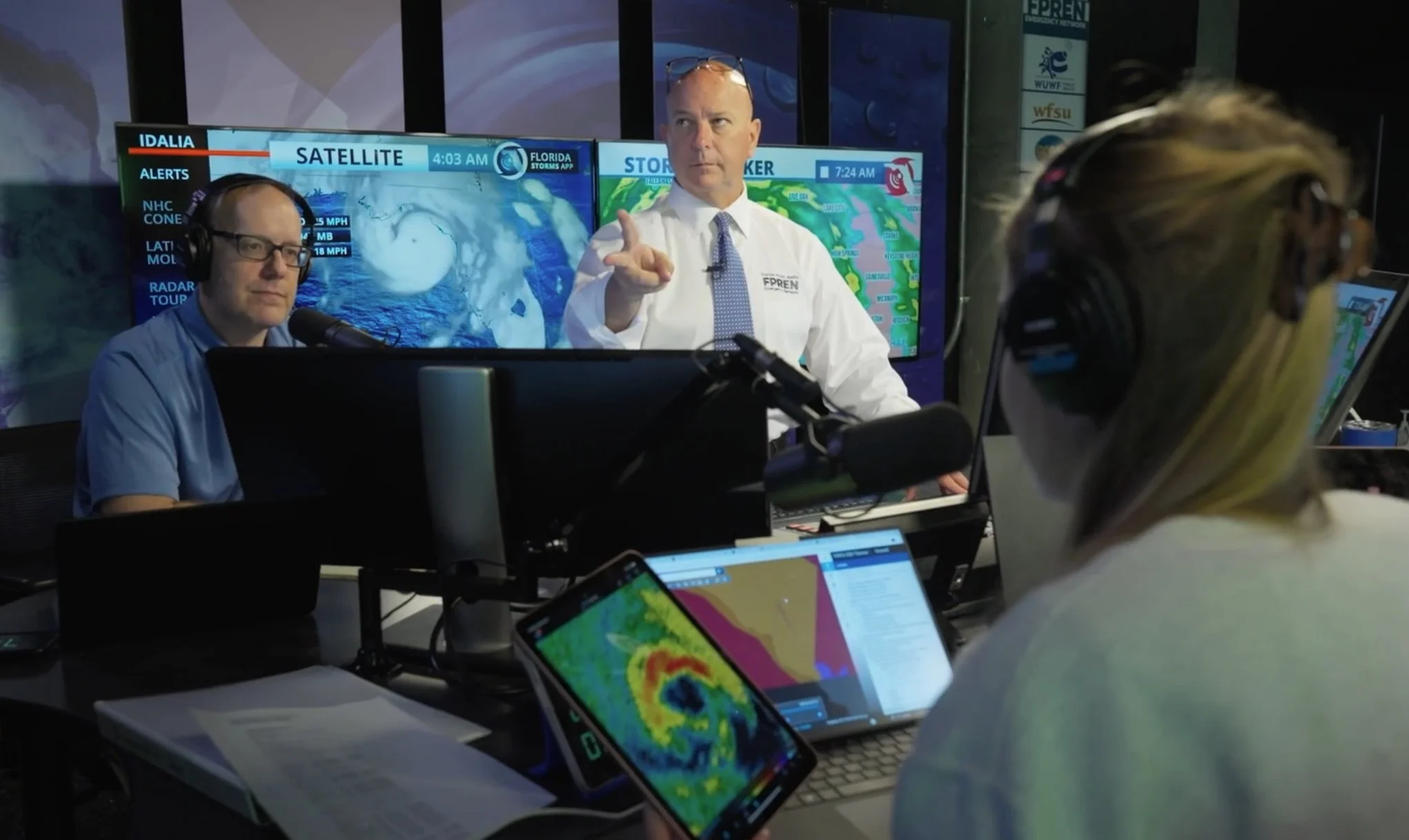
Photo courtesy of the University of Florida
Public Media Bridge Fund Invests More Than $2 Million to Expand Public Safety Information Service and Strengthen Local Public Media
Seven grants will support the regional expansion of a proven emergency communications network, establish shared services across Illinois public radio stations, and restore essential local public media service in communities affected by extreme weather events.
BOULDER, Colo. — Nov. 23, 2026 — Today, the Public Media Bridge Fund announced more than $2 million in grants aimed at helping local public media organizations better serve their communities while building a stronger, more resilient public media system. The seven investments — which benefit more than 25 local public media organizations — will support innovative approaches to delivering essential emergency information, strengthening operational capacity and securing local service.
At $1.2 million, the largest investment will support the regional expansion of Public Media Alerts (PMA), known in Florida as the Florida Public Radio Emergency Network (FPREN). Established in 2013 at WUFT-TV/FM at the University of Florida, PMA has brought together 14 public media organizations across the state to provide coordinated coverage of natural disasters, including hurricanes, flash floods and other public safety emergencies across broadcast, digital and social platforms. With support from the Bridge Fund, PMA will build on FPREN’s proven model to help public media organizations across an additional 10 states in the U.S. Southeast and Midwest deliver timely, accurate and potentially lifesaving information to their communities before, during and after emergencies.
“Our team couldn’t be more excited about sharing the successful and proven FPREN model with our colleagues around the nation and appreciates the support from the Public Media Bridge Fund, which is making it possible,” said Randy Wright, executive director of the University of Florida’s Division of Media Properties and the founder of FPREN. “PMA is truly a shared experience that provides stations with new and unmatched tools, resources and expertise that have typically never been available to local public media organizations. While PMA is founded in the incredible resiliency of our broadcast infrastructure, it also provides stations with alerting content that supports each of their media platforms, including digital and social. PMA is the best of public media: innovative, efficient, sustainable, effective and, most of all, true to our north star of service and community impact.”
Through PMA, participating stations will gain access to shared meteorological expertise, technology and emergency information resources, including direct connections to the National Weather Service and the Federal Emergency Management Agency’s (FEMA) Integrated Public Alert and Warning System. These resources will help local public media organizations deliver locally relevant information during emergencies, coordinate coverage across state lines and ensure communities have reliable information when they need it most.
“What FPREN has done in Florida has been a game changer for the public and for alerting agencies. They take official alerts and National Weather Service forecasts and warnings, explain what they mean locally, and tell people what they need to do to prepare and act. During disasters, they also get information from state and local emergency managers and take that messaging directly to the public. It's information people can use, without the hype. We've seen how well that works in Florida for more than 13 years, and now we have a model for doing it across the country,” said Craig Fugate, former FEMA administrator and former director of the Florida Division of Emergency Management.
“In emergency situations, access to trusted, reliable public safety information makes all the difference,” said Erik Langner, executive director of the Public Media Bridge Fund. “Public Media Alerts demonstrates how public media can leverage shared expertise and technical infrastructure to deliver an essential service that no single station could provide as efficiently or effectively on its own. By investing in innovative, collaborative approaches like PMA, we’re helping local public media organizations strengthen their service to communities while building a more resilient system.”
Further details about PMA’s regional expansion — including initial states and stations involved — will be available in the coming weeks. For more information, visit PublicMediaAlerts.org.
The Bridge Fund is also investing $500,000 in Illinois Public Broadcasters through the Collaborative Operating Models program to establish shared traffic and streaming services among 10 public radio stations across the state. By reducing operational duplication and sharing resources, the statewide initiative aims to help Illinois public radio stations operate more efficiently and strengthen local service.
“Illinois public radio stations are grateful to the Bridge Fund for providing startup resources for this project,” said Heather Norman, president of IPB and general manager of Tri-States Public Radio. “Shared services will allow stations to devote more resources to serving our local communities. This investment comes at a critical time, helping sustain strong local service despite the loss of federal funding.”
Two additional grants through the Collaborative Operating Models program will support organizational partnerships that aim to preserve and expand local public media service. First, WHYY was awarded $100,000 to support the integration of WPSU in State College, Pennsylvania, following its recent acquisition. This partnership ensures the continuation of trusted public media programming and services for approximately 1.5 million residents of central Pennsylvania after the threat of WPSU’s closure last fall. Second, Radio Catskill in Liberty, New York, was awarded $30,000 to support its merger with community radio station WIOX in nearby Roxbury, New York. The merger will allow Radio Catskill to expand its service — including local news coverage — across New York state, deepen its roots in the Catskills region and create new opportunities for financial sustainability.
Finally, the Bridge Fund awarded three Disaster Recovery grants to help restore critical public media infrastructure damaged by natural disasters and other extreme weather. The grants include $85,000 to KCCU in Lawton, Oklahoma, to repair a storm-damaged transmitter; $5,500 to KKCR on Kaua’i, Hawaii, to restore service in the immediate aftermath of Hurricane Lowell; and $100,000 to KCHU in Valdez, Alaska, to replace a tower and transmitter that serve 14 rural Alaska communities and were damaged by glacial melt and river erosion.
Altogether, these investments reflect the Bridge Fund’s commitment to protecting essential local public media service following the rescission of federal funding last year while supporting collaborative, scalable solutions that can strengthen the system for decades to come.
###
About the Public Media Bridge Fund
The Public Media Bridge Fund, an initiative of Public Media Company, is designed to guide local public media through a crisis moment to a more sustainable, vibrant, and impactful future. Launched in 2025, the Bridge Fund has raised over $90 million to date with the mission of maintaining public media service across the country; protecting essential infrastructure for local, nonprofit use; and strengthening system-wide resilience and community value for the long-term. The Bridge Fund’s strategy is rooted in a sequential and progressive framework, beginning with stabilization and moving through sustainability with the ultimate goal of adapting the system to solidify public media as a cornerstone of a more connected society. For more information, visit publicmediabridgefund.org.
Media Contact: Louisa Lincoln, Head of Impact & Engagement, louisa@publicmedia.co