
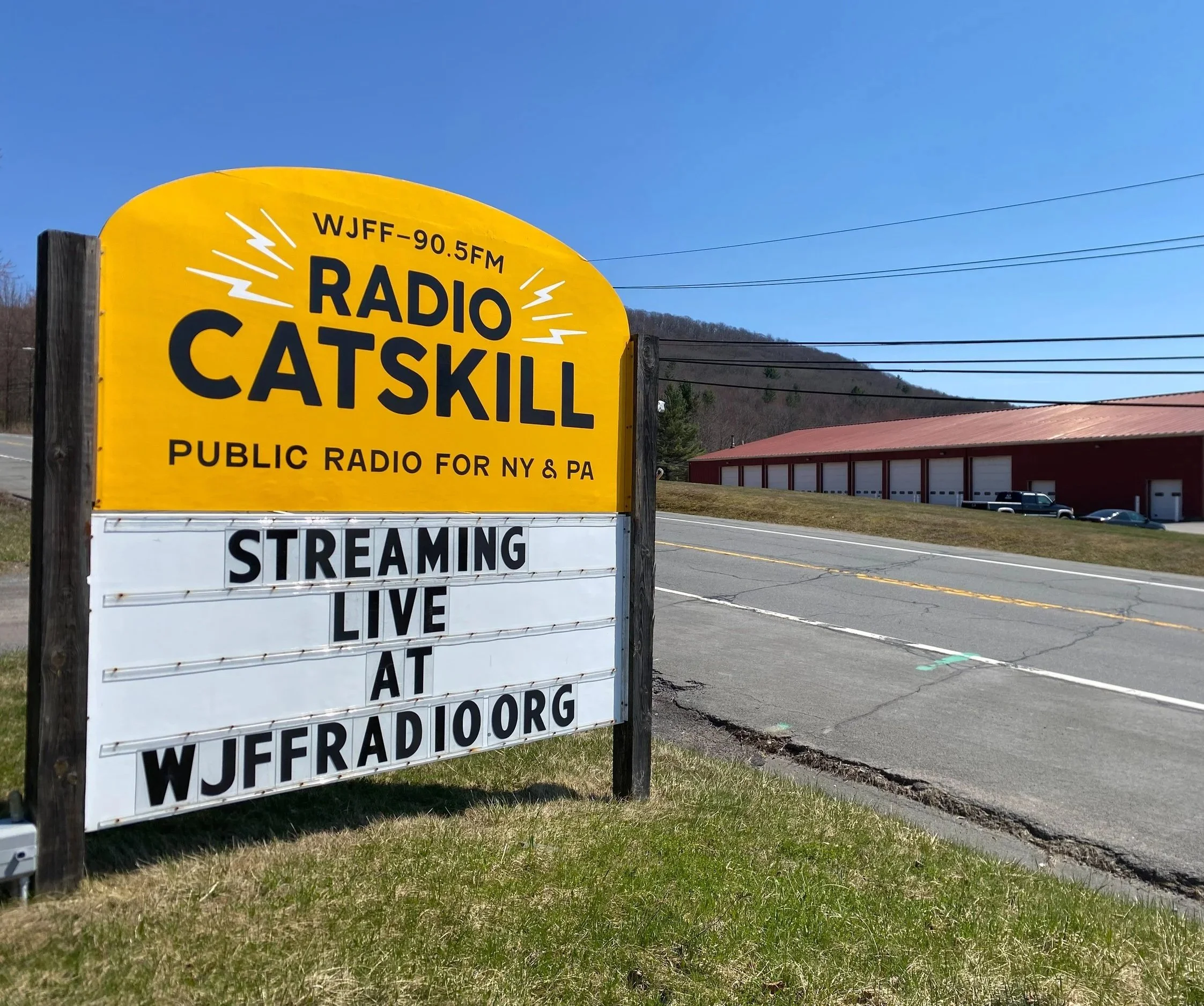
Photo: Patricio Robayo / Radio Catskill
Case Study: How Radio Catskill is Expanding Local Public Media Service in Upstate New York
Last month, Bridge Fund grantee Radio Catskill in Liberty, New York, announced that they are joining forces with community radio station WIOX, in nearby Roxbury, New York. The merger will allow Radio Catskill to expand their service area across New York state, deepen their community roots in the Catskills region, and create new opportunities for financial sustainability.
According to Mimi Bradley, Radio Catskill’s Director of Development and Operations, the agreement came together through a series of conversations over the last year. “This opportunity came along at really the perfect time for us, when we could integrate this into our sustainability planning for the future,” Bradley said. “We recognized that the way we were going to continue to thrive was through growth and through collaboration.”
The Bridge Fund spoke with Bradley to learn how this partnership came together and what other stations can learn from their experience. This interview has been lightly edited for clarity.
Bridge Fund (BF): Can you share a bit more about how this merger of Radio Catskill and WIOX came together?
Mimi Bradley (MB): About a year ago, we received a phone call from WIOX saying that they were interested in talking to us. Their radio station is an all-volunteer-run community radio station, and the volunteers who had been running it were beginning to age out and didn’t have the administrative support they needed. They really wanted to keep the station alive because it serves a really important community purpose. Many, many conversations later, we now find ourselves at a place where we have a signed MOU [Memorandum of Understanding] to acquire all of their assets, including their FCC license. We’re currently working on a PSOA [Public Service Operating Agreement] that will give us a roadmap to move forward after this.
It’s really exciting — it’s exciting for all of us. It allows for our reach to expand further in the Catskills. Their broadcast footprint does not intersect with ours at all, but it’s also a very natural expansion. It brings us further out into Delaware County, which we reach a little of now, but this will get us out there in a bigger way and into Greene and Schoharie Counties as well. It has felt very collaborative in terms of the conversations. I think that WIOX is really excited that the station will continue. So far, we’ve had a town hall meeting for our folks over here and in Roxbury, and will continue to have a presence out there.
BF: The details of the merger are still being finalized, but what do you expect the combined service will look like?
MB: We’ve been reviewing all their programming. Their schedule is quite different from ours — mostly music shows and local talk. We carry NPR, we report local news, we have local music shows. They don’t carry any global programming except for Democracy Now!, which incidentally, they broadcast at the same time that we do, so that will be good for their listeners. What we’re looking to do is integrate the best of what they offer into our schedule, while keeping the main pillars of our programming intact. We’re still reviewing things and trying to figure out how that’s going to work.
We’re setting it up as a simulcast, so we will become one service called Radio Catskill on both frequencies. It requires some upgrades to their studios, which we have already begun, but I think it’ll be really, really helpful for us in terms of expanding our reach, and also really helpful for the listeners out there who don’t have a lot of options for picking up the NPR programming that we offer. One of the most important things that we’ve been doing over the last few years is expanding our local news reporting, so this also gives us an additional opportunity to broaden our outreach and expand our reporting.
BF: For someone who isn’t familiar with the Catskills area, what does the media landscape look like there, especially in terms of local news?
MB: We are very rural, and where WIOX is [located] is even more rural. So, in terms of local news, we here, in our area, have two local newspapers that publish a couple of times a week — by the time our newspaper is published, the news is already sort of dated. We’ve really taken it upon ourselves to try to offer real-time reporting on multiple platforms, so that we’re meeting our audience where they are. So that means on air, online, through our weekly newsletter, on social media. I wouldn’t call us a local news desert, because I think the work that our newspapers are doing is good work, and certainly we’re stepping up to fill the gaps, but there’s not a ton available. I would say it’s the same out in Roxbury, where WIOX is located. From the studios, it’s about an hour and 15 minute drive there.
BF: And was there any kind of previous relationship between the two organizations, before these conversations got underway?
MB: No. We knew of them, certainly, as we know of all of the public radio stations that are in our area, but there was not a pre-existing relationship. A few of our longtime hosts were pretty familiar with them. We’ve had a few people come and say, ‘Oh, I visited their studios 10 years ago, and I really love what they do out there.’ But in terms of anything formal, this is the first.
BF: What has that relationship-building process looked like for your team? Starting from scratch, establishing trust with the organization, creating a rapport, etc.
MB: It’s an ongoing process. We want to make sure that our listeners know that we will continue to bring them the public service that they’re used to, while also letting the WIOX listeners know that what we bring is additive, and it’s not going to be taking anything away from them. Certainly, their programming will change, but I think what we’re offering is incredibly valuable to their community. We’re fortunate that the folks from WIOX that we’ve been working with on this are wonderful people who are incredibly committed to public media and are very enthusiastic about what we do.
Up to this point, it’s been a relatively painless process. It’s been really collaborative, we’ve had a lot of conversations, but I think just continuing to get in front of people and reassuring them about what this means is going to be incredibly important. To that end, the studios in Roxbury will remain. We’re looking at staffing models that include a presence out in Roxbury. I imagine that, at least at first, I’ll be going out there pretty regularly. But we are looking to expand staff to cover the reporting in that area, and the administrative work that needs to be done to keep the station running.
I’ve been fortunate in my visits to Roxbury so far to meet a few of their underwriters and a few of the local business owners, and they’ve all been extremely welcoming. I would hesitate to say that there won’t be minor hiccups along the way, because of course there will be, but up until this point, it’s been pretty smooth sailing.
And, again, we’re just so committed to making sure that we have a presence there in addition to our presence here, and making sure the listeners know that we will be there, we will be supporting them, and we will be offering them the same public service that we do here.
BF: What about this process has worked well for you and your team?
MB: I think the overall vision has worked really well. CPB funding made up a larger percentage of our budget than any other public radio station in New York state. So, the loss of that funding was incredibly scary for us, and we had a lot of internal conversations about long-term sustainability and how we would make that work. We did so many financial models just looking at how we would continue.
We were incredibly fortunate to have a groundswell of community support right off the bat that took care of us in the short term. And then, of course, to have the Public Media Bridge Fund step in, that was a huge, huge help for us. But it remained to be seen how long that community support would be able to continue at that higher level.
So this opportunity came along at the perfect time for us, when we could integrate this into our sustainability planning, and recognize that the way we were going to continue to thrive was through growth and through collaboration. So, that all lined up perfectly, and the timing lined up perfectly.
Outside of that, the response we’ve gotten from our community has been really wonderful. You never know if a squeaky wheel is going to show up and have outsized questions or concerns. But I have not heard one critical comment up until this point from anyone about this. So, that continues to show me that this is the right decision for us. And as long as we take every step carefully and with attention on our listeners and on our future listeners out there, this is going to be a win-win for everybody.
BF: What insights or learnings have you garnered or experienced through this period and through this relationship-building with WIOX that you think maybe other public media organizations could learn from?
MB: I think the notion that we’re stronger together is the most important bit of learning that I’ve taken from all of this. At the end of the day, all of us in this field are committed to public media, all of us are committed to local news, but it takes a village in order to make that work without federal funding.
I think being open to an opportunity that might not have occurred to you is really important. We need to be thinking in new ways than we have prior to this. If you had asked me a year and a half ago whether we would be in this position right now, I never would have thought that this would be where we are. And I don’t even know that I would have thought it was a good idea to be where we are. But in going through this process and having so many conversations with so many stakeholders and interested parties, my colleagues and I kept turning to each other and asking, “is this the right thing?” And the answer kept being yes.
Making sure that you’re doing the work of financial modeling in the background --- that’s essential. We have a number of budgets currently running right now that we consistently go back through and double check and triple check to make sure that this is going to work for us.. But, it’s great — I mean, it feels like we’re prepared, so that’s a good thing.
I would also say having a strong and dedicated board has been really essential through this process. They have been instrumental in moving things along, and working with the lawyers, and meeting the folks at WIOX, and making inroads into the community. Having their buy-in has been really, really essential.
BF: And when did you bring the board into the process?
MB: We brought them in pretty much immediately. I think that Tim [Bruno], the general manager here, maybe had one conversation with WIOX before mentioning it to the board, and because of the crazy timing of all of this, when the CPB funding went away, we started pushing it a lot harder because financially it seemed like the right thing to do in terms of filling some of the holes that were left by the lost funding.
The other thing that worked was having a couple people on the board that asked hard questions and weren’t immediately on board with the idea — that made us stop and look harder at things and further investigate. If everybody on the board had immediately said yes, I don’t know that we would have done the important work that we needed to do in order to get to this point and feel 100% confident about where we are.
BF: To close, what will this merger with WIOX allow you to do together that you couldn’t have done separately? How does this make you both greater than the sum of your parts?
MB: It allows us to better serve the community. It allows us to expand our reach and expand the reach of public radio. It allows both of us to achieve administrative efficiencies, which is something that you all [at the Bridge Fund] have been talking about in your sustainability program, as well. And it allows for us to share resources, which will, in time, ensure the long term sustainability of the station, of Radio Catskill.
—
Congratulations to the entire Radio Catskill team! Learn more about their work at wjffradio.org.